The short answer: Before design validation. Once a medical device design is validated, it almost never changes. If the part is hard to automate, you pay for that in every machine you buy for the life of the product. A design review with an automation engineer during development costs very little and can cut automation cost a lot.
Andy Larson, founder of Custom Automation Inc. (now part of Pezo), has seen this play out for nearly 40 years. His view is simple: the earlier medical device companies get automation people involved, the better it is for them.
Why validation locks you in
Medical devices are often developed fast. Then the team documents and validates everything. After that, the design is frozen.
Andy has been in many rooms where the automation team says, "We could cut the cost of this machine in half if we could change this one feature." And the answer is, "No. It's already validated."
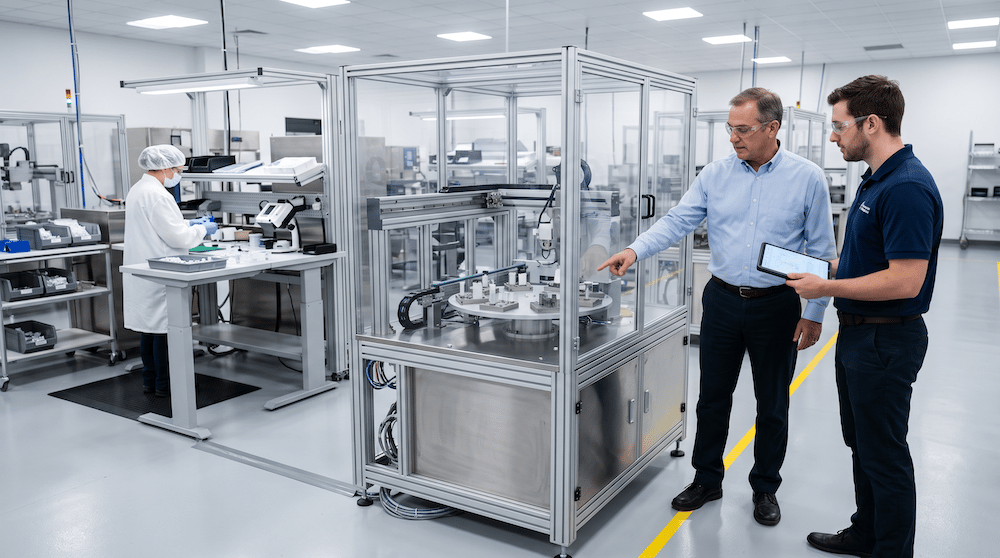
The machine then has to be built around the part as it is. That can mean more stations, more vision checks, more custom tooling, and a longer build. All of that costs money and time.
What an automation engineer looks for in an early design review
These are the questions we ask when we look at a part before it is locked:
- Can a machine tell which way the part is facing? A small flat, notch, or tab can make feeding and orienting much simpler.
- Can it be gripped? Parts need a place a gripper or nest can hold without damaging a critical surface or coating.
- Does it assemble from one direction? Top-down assembly is simpler than parts that need to be flipped or rotated mid-process.
- Are the tolerances consistent? A person adjusts to a slightly off part without thinking. A machine without vision can't. Incoming parts need to be more consistent for automation than for hand assembly.
- Can vision check what matters? If a key feature can't be seen by a camera, it is hard to mistake-proof.
- Can parts be combined? Fewer parts means fewer stations.
None of these change what the device does. They change how easy it is to build at volume.
Signs it is time to bring automation in
- A volume ramp is coming. When a product moves toward commercial launch, teams start to worry about keeping up. That is the time to plan, not after the backlog starts.
- Parts are too small for hands. If operators are building under a microscope all day, quality and ergonomics will both suffer as volume grows.
- Scrap is high. On one line we worked on, a semi-automated fixture took scrap from 32% to 2%.
- The company was just acquired. Startups rarely invest in automation. Once a larger OEM buys them, scale-up becomes a priority fast.
Start with semi-automation in R&D
You do not have to jump to a full automated line. Many of our projects start with a simple semi-automated fixture during development.
The first version is just enough to build parts and learn the process. The team uses it to dial in settings and find what matters. By the time the product reaches production, everyone knows exactly what the full machine needs to do. That makes the final machine faster to design and more likely to work the first time.
A note for startups
Andy is honest about this. In his experience, medical device startups rarely buy automation. Their goal is often to prove the product and sell the company. That is fine.
But a short design review costs very little. If a startup designs for automation early, the product is easier to scale. That can make it more attractive to a buyer.
Remember the timeline
A custom machine often takes about a year from order to production. (See: How Long Does It Take to Implement Custom Automation?) If you wait until after launch to start, you will be building by hand for longer than you planned.
Frequently asked questions
When should automation engineers get involved in medical device development? Before design validation. After validation, the design rarely changes. Early input can make the part easier to feed, orient, assemble, and inspect by machine.
What is design for automation? Design for automation means shaping a part so a machine can handle it reliably. That includes features for orientation, places to grip, one-direction assembly, consistent tolerances, and features a camera can check.
Do medical device startups need to plan for automation? Most startups do not buy automation before they are acquired. A short design review is still worth it. It makes the product easier to scale later.
What is a semi-automated fixture? It is a fixture that helps an operator build a part more consistently, often with guides, nests, or simple motion. It is a common first step before full automation and can reduce scrap a lot.
Get a second set of eyes on your design
If you have a product in development, a short review now can save a lot later. Book a free automation audit. One of our engineers will look at your parts and your process and tell you what to watch for before your design is locked.
Book a Free Automation Audit